The Pothole A Church Patched Three Times Before Fixing The Base

Three patches went into that hole. Three springs it opened again, same edge, same crumbling shape. The trustee board at a 120-space church lot in north St. Louis County bought cold mix by the bag for two winters before anyone asked why the failure kept landing in exactly one spot. The answer was underneath it. A volunteer board buying asphalt repair st louis mo out of a fixed annual budget gets offered surface work first, and surface work cannot fix a failed base, which is why the cheap line item on this lot turned out to be the expensive one. That is what the repair proved, receipt by receipt.
The first attempt ran about $450 one October, eight bags of cold mix and a member with a pickup. It held until the March thaw. The second attempt used a contractor’s bagged patch and a plate compactor, closer to $600, and it survived into the following winter before the edges came apart again. The third cost $700 and failed inside four months, at which point the finance committee added it up and found roughly $1,750 spent on a hole that was wider than when it started. Treat those as an example scenario rather than a quote, though the shape of them is real enough: the spending climbed while the defect grew.
Water Under The Surface Was Winning
A pothole is the visible end of something that started in the aggregate base below the pavement. Water works in through a crack, sits in that base, freezes, and lifts the asphalt off the material meant to hold it up. Traffic then pumps the softened base out through the crack every time a car rolls across. Cold patch fills the void at the top and leaves the void at the bottom completely alone. The case we see most often is not a bad patch at all, it is a competent patch resting on ground nobody repaired, which is why it reopens on the same footprint each spring instead of somewhere new. On this lot the entrance sat at the low point of the grade and a downspout off the fellowship hall drained toward it, so the base under that one square of pavement stayed saturated from November through April while the rest of the lot dried out fine.
Ask where the water goes first. Every quote for asphalt repair st louis mo work should name which of three paths it is selling: surface patching, an overlay, or excavation down to the base and replacement. Ford Asphalt’s own repair page puts surface patching at three to five years of service and full-depth repair at ten to twelve, and it recommends an overlay or repaving once roughly 30% of a lot needs work. Those numbers are how a volunteer board tells the difference between buying time and buying a fix.
Excavation Priced Higher And Lasted Longer
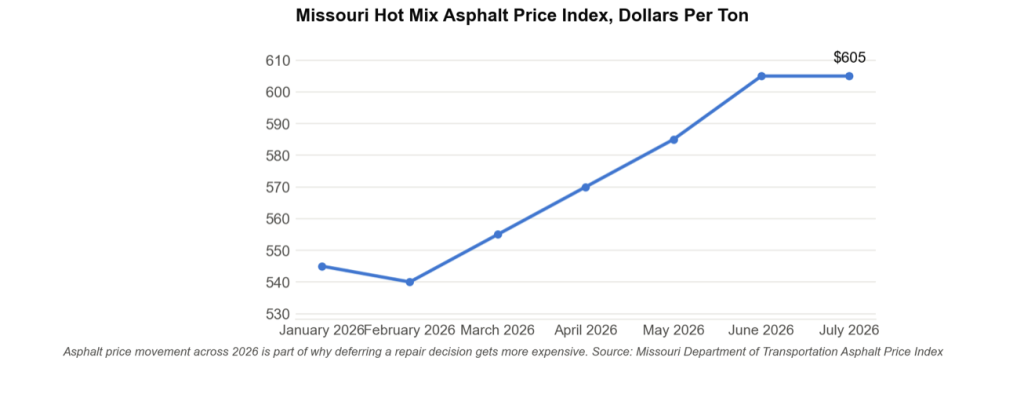
Excavation on a 12 by 14 foot section came in around $3,200 in this scenario: saw cut the perimeter, haul off the old asphalt and the wet base, bring in clean rock, compact it in lifts, then lay hot mix in two courses. Set against $1,750 already spent and gone, the comparison stopped being close. Scheduling was the harder part, because crews book out further than most boards expect. A July 2026 survey of construction firms found 45% reporting that labor shortages are directly delaying projects, with 92% saying they struggle to fill open positions, and the Associated General Contractors of America has been tracking that squeeze all year. Material pricing moves too, which is the other half of the case against waiting a season to decide.
Week By Week Through The Repair
Work started on a Monday and the entrance was coned off by eight in the morning. Saw cutting and demolition filled the first day, and the crew found wet base fourteen inches down, deeper than the quote assumed, so a change order added $340. By day three the new rock was in and compacted, and the hole sat open one more night while the compaction got checked. Paving happened Thursday morning and the patch took traffic that same evening once the mix cooled. The board was told to keep heavy delivery trucks off it for the first week and to leave the joint unsealed until the following spring, roughly 9 months in, so the new asphalt could cure and settle first.
Why Trustees Stopped Buying Patch Material
Two years on, that square of pavement is the only part of the lot nobody brings up at a meeting. A daycare director a few miles east told a nearly identical story last year: four patches at one dumpster pad, then a single excavation, and the line item vanished from her budget for good. The pattern holds because the repair finally matched the failure instead of covering it. A $12,000 annual budget can absorb one real fix; what it cannot absorb is the same false one every March.